How visible is St Andrews in AI conversations?

The traditional idea of a print prospectus is fading, and increasingly, websites are not the ‘digital front door’ for users but rather repositories of information that are quietly harvested, indexed and reinterpreted by artificial intelligence. In this new landscape, visibility is not about what’s on the homepage, but about what’s discoverable, credible and reusable within the vast ecosystems of AI models that shape user decisions.
Search engines are giving way to conversation engines. When someone asks ChatGPT which university offers the best course, or which UK institution is known for a certain subject, the answer draws not from our carefully designed web journeys but from the data that represents us out there on the open web. As AI becomes the intermediary between audiences and information, understanding how St Andrews is represented in these systems will become as crucial as understanding our position in traditional search result rankings.
Why measure AI representation?
Prospective students increasingly turn to AI tools for guidance. Instead of typing ‘best UK universities for history’ into a traditional search, they ask, ‘Which UK university is best for studying history?’ and receive an instant, AI-powered conversational answer. This shift means universities must think differently about how their content is structured, how their reputation data circulates, and how algorithms rather than humans are representing their stories.
Understanding how and where our content appears in AI responses is becoming essential. Universities invest in producing digital materials, webpages, news, research outputs and social posts, but the way AI utilises this content is still largely invisible.
By measuring how often and in what context the University of St Andrews appears in AI-driven responses, we can start to understand the broader impact of our digital footprint.
This is no longer simply a question of SEO or web analytics; it’s about how machine learning systems interpret and represent our identity.
Research aim
This project aimed to assess the extent to which the University of St Andrews is represented in discussions with ChatGPT. The study serves as a benchmark indication of how effectively the University’s digital presence is being captured and reflected within AI-driven decision-making processes.
Methodology
A dataset of more than 3,000 questions across 67 categories was created. These questions mirror those typically asked by prospective students when exploring UK universities, covering topics from lifestyle and student experience to academic quality and reputation.
Examples included:
- Which UK university has the best sports facilities for students?
- Provide the top 20 UK universities for studying Comparative Literature
Each question was asked of ChatGPT-5 on Monday 3 November 2025, and the responses were recorded and analysed. Every response was reviewed to determine which UK universities were mentioned, and how prominently.
A simple scoring system was used:
- a response such as ‘St Andrews is the best’ received a score of 1.0
- a response such as ‘Leeds, St Andrews and Bath are all good choices’ allocated a score of 0.5 to each
- if a university was not mentioned, it scored 0
The results were then averaged by question category, producing a map of how ChatGPT represents St Andrews relative to other UK institutions.
Some key findings:
- The subject areas where St Andrews features strongly are Finance, Film Studies and Marine Biology.
- For most other courses, St Andrews is in the conversation but may not be the primary recommendation.
- There are a few subjects where St Andrews does not get mentioned, such as Data Science, Chinese studies, Art and Music.
- The University also features strongly in overall experience and student wellbeing, but is not rated in terms of prestige.

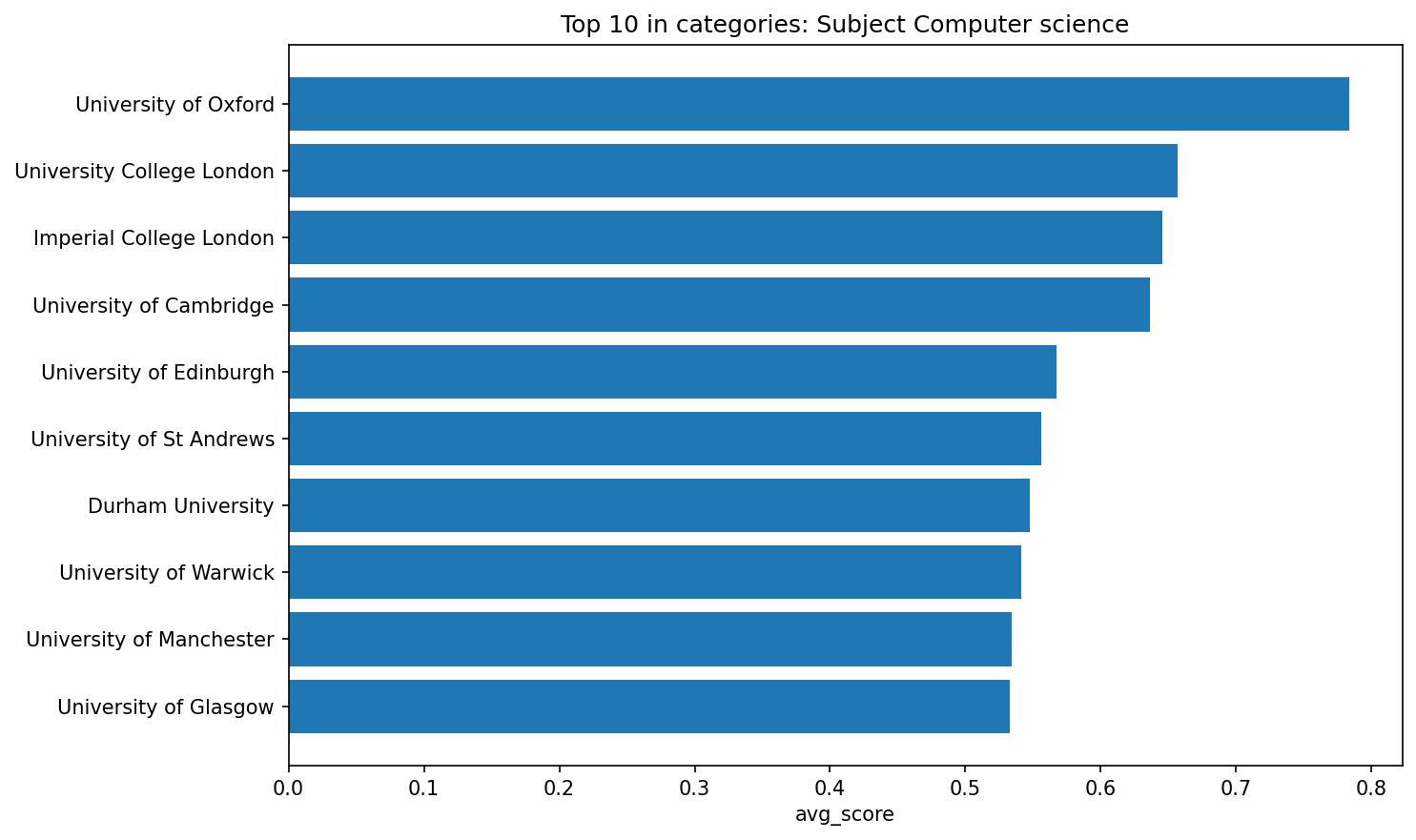
This study marks a first step in understanding St Andrews’ visibility within the new world of AI-driven discovery. This project is a reminder that digital reputation isn’t simply built – it’s interpreted, indexed and retold by machines. The results demonstrate strong recognition in areas such as Marine Biology, Film Studies and Finance, but also highlight opportunities to enhance representation across a broader range of subjects.